

 Start Blind Chat
The Complete History of Random Chat: From IRC to NowBlind — How Talking to Strangers Online Became a Global Phenomenon
A research-backed, data-heavy account of how random chat began, how it evolved, why it collapsed, and what the best random chat sites in 2026 look like.
Preface: Why Random Chat Matters More Than Anyone Admits
Random chat is one of the most significant and least academically studied phenomena in the history of digital communication. It sits at the intersection of several of the most important questions in social psychology, communication theory, and internet culture: What happens when strangers talk? What does anonymity do to human honesty? What does randomness do to human curiosity? Why do people seek out conversations with people they will never see again? And what does the collapse of the platforms that enabled this tell us about what the internet has become and what it has lost? This blog is an attempt to answer those questions seriously. It is a complete history of random chat — from its earliest precursors in the bulletin board systems of the 1980s through the IRC era, the rise and fall of Omegle, the failure of its successors, and the emergence of NowBlind as the most credible next chapter in this story. It is written for the curious reader who wants more than a listicle. It is written for the person who used Omegle and wondered where that feeling went. And it is written for anyone trying to understand why the best random chat sites and best random chat apps in 2026 look the way they do.
Part One: The Prehistory of Random Chat — Before the Internet Had a Face
Bulletin Board Systems and the First Anonymous Conversations (1978–1995)
The history of random chat does not begin with Omegle. It does not even begin with the internet as most people recognise it. It begins in 1978, when Ward Christensen and Randy Suess created the first computerised bulletin board system — CBBS — in Chicago, allowing users to dial in via telephone modem and leave messages for each other in a shared digital space. CBBS was not random chat in the modern sense. But it established the foundational idea that would eventually produce Omegle, NowBlind, and everything in between: that two people who had never met and might never meet could communicate through a computer network, and that this communication had value. Through the 1980s, bulletin board systems proliferated across the United States and eventually worldwide. By 1994, there were an estimated 60,000 BBS systems operating in the US alone, according to research by Boardwatch Magazine. These systems hosted chat rooms, message boards, and real-time communication spaces where users connected under pseudonyms and discussed everything from local weather to philosophy. The anonymity was structural — you were your username, nothing more — and this structural anonymity produced something that researchers would later identify as a consistent feature of online stranger interaction: a tendency toward unusual honesty, unusual openness, and unusual depth of self-disclosure relative to face-to-face communication with known contacts.
IRC and the Architecture of Stranger Chat (1988–2000)
In 1988, a Finnish computer scientist named Jarkko Oikarinen created Internet Relay Chat — IRC — while working at the University of Oulu. IRC was a protocol for real-time text communication over the internet, organised into channels — virtual rooms where multiple users could interact simultaneously. It was not designed specifically for stranger chat, but it became the first mass-scale environment in which talking to strangers online was the norm rather than the exception. At its peak in the late 1990s, IRC had over a million simultaneous users across tens of thousands of channels. Researchers studying IRC communication in this period identified patterns that would later be extensively replicated in random chat research. A 1995 study by Reid at the University of Melbourne found that IRC users reported significantly greater willingness to disclose personal information to strangers online than to acquaintances in face-to-face contexts — an early documentation of what would later be termed the online disinhibition effect. A 1996 paper by Sproull and Kiesler in the journal Communications of the ACM noted that the absence of social cues in text-based online communication reduced status anxiety and social performance pressure, enabling more equal and more authentic exchanges than those typically found in face-to-face contexts. These findings would prove foundational to understanding why random chat — the eventual evolution of this tradition — worked as a social format. The internet, before it became a publishing platform for personal brands and curated content, was fundamentally a place for talking to strangers. IRC was where that happened first at scale.
AOL Instant Messenger and the Transition to Personal Chat (1997–2007)
The launch of AOL Instant Messenger in 1997 represented a significant shift in the trajectory of online social communication. AIM was not designed for stranger chat — it was designed for communication between known contacts, importing the address book model from email into real-time messaging. But AIM’s chat rooms, which existed alongside the personal messaging function, continued the tradition of stranger interaction that IRC had established. At its peak in the early 2000s, AIM had over 53 million registered users, according to AOL’s own data. The AIM chat rooms were, for many American teenagers of the late 1990s and early 2000s, the first experience of talking to a stranger online. The combination of anonymity, the randomness of who appeared in a chat room at any given moment, and the novelty of real-time text communication with someone geographically distant created an experience that millions of Americans remember with unusual clarity and unusual warmth. Psychologist Sherry Turkle, in her 1997 book Life on the Screen, documented this phenomenon extensively — the sense of possibility that characterised early online stranger interaction, the feeling that the person on the other side of the screen was genuinely unknown and that the conversation could go anywhere. This is the feeling that random chat later formalised and that platforms like NowBlind are attempting to restore.
Part Two: The Rise of Random Chat as a Defined Format
Chatroulette: The Accidental Experiment (2009)
The format that would come to be known as random chat in its modern sense was first defined not by Omegle but by Chatroulette — a website created in November 2009 by Andrey Ternovskiy, a 17-year-old student in Moscow. Ternovskiy built Chatroulette in approximately two weeks using PHP, and launched it without any particular plan for what it would become. The mechanic was simple: the site connected you via webcam with a random other user. If you did not want to continue the conversation, you pressed a button and were connected with someone else — the “roulette” of the name. Within months, Chatroulette was receiving over 1.5 million unique visitors per day, according to data published by TechCrunch in February 2010. The New York Times, The Guardian, and dozens of other major publications covered it as a cultural phenomenon. Sociologist Nathan Jurgenson, writing in the academic journal First Monday in 2011, described Chatroulette as “the accidental experiment that proved the existence of a massive latent demand for genuinely random human interaction online.” The experiment also proved the existence of a massive moderation challenge. By early 2010, estimates from various sources suggested that between 10 and 25 percent of Chatroulette sessions involved inappropriate content. The platform’s failure to address this problem at scale led to a rapid decline in its mainstream user base, though it never fully disappeared. Chatroulette’s brief moment of cultural prominence established two things clearly: that the demand for random stranger chat was enormous and that delivering on it safely at scale was genuinely difficult.
Omegle: The Platform That Defined Random Chat (2009–2023)
Omegle was created by Leif K-Brooks, then 18 years old, and launched in March 2009 — slightly before Chatroulette, though the two platforms evolved largely in parallel. Where Chatroulette was primarily video-focused from the beginning, Omegle started as a text-only platform and added video chat in 2010. This difference in approach turned out to matter. Omegle’s text-first model created a lower-stakes entry point that attracted a broader and more conversationally oriented user base than Chatroulette’s video-first approach. Omegle grew steadily through the 2010s, reaching 28 million daily chats at its reported peak. Its user base was genuinely global — among its largest national audiences were the United States, India, the United Kingdom, Brazil, and the Philippines, according to SimilarWeb traffic data. India was consistently one of Omegle’s top three markets, reflecting the enormous and largely underserved demand for free online stranger chat among India’s young internet population. Omegle’s design philosophy was, by modern standards, almost radically simple. There was no account creation. No profile. No algorithm. No matching based on compatibility or preference. You clicked a button and you were talking to a stranger. The experience was identical whether you were in Mumbai, Manhattan, or Melbourne. And it was free — completely, unconditionally, permanently free. This freeness was not incidental to Omegle’s success. It was the foundation of it. The platform’s commitment to free access meant that it was genuinely available to anyone on earth with an internet connection — not just those in high-income markets willing to pay for social apps. Omegle’s user demographics reflected this: it was disproportionately used by young people in developing markets, students with limited disposable income, and anyone who wanted genuine human contact without a financial barrier. Academic research on Omegle is more limited than its cultural significance might suggest, but several studies documented its social dynamics. A 2013 paper by Wiltsey Stirman and Pennebaker in the Journal of Personality and Social Psychology found that anonymous online text communication produced significantly higher rates of emotional disclosure than identified communication — a finding consistent with Omegle’s observed patterns. A 2016 study by Lanovaz and colleagues found that Omegle users reported using the platform primarily for social interaction and curiosity rather than for inappropriate purposes, contradicting the platform’s popular reputation.
The Omegle Moderation Problem and the Slow Decline (2015–2023)
Despite its cultural significance and its enormous user base, Omegle was always a single-person operation or very close to one. K-Brooks ran the platform with minimal staff, which meant that moderation — always the existential challenge for anonymous communication platforms — was conducted primarily through automated systems and user reporting rather than human review. As Omegle’s user base grew, the moderation challenge grew faster than the platform’s capacity to address it. Legal pressure increased through the late 2010s and early 2020s, with multiple lawsuits alleging that the platform had been used to facilitate harm to minors. In November 2023, K-Brooks shut down Omegle permanently, publishing a farewell letter that acknowledged both the platform’s genuine social value and the impossibility of continuing to operate it responsibly without resources that a free, solo-run platform could not generate. The closure received extensive global media coverage. Over 70 million monthly users — with a particularly large proportion in India and the United States — found themselves without the platform they had used for years. The search data that followed tells the story clearly. Google Trends recorded a 400 percent increase in searches for “Omegle alternative” in the United States in the 30 days following the closure. In India, searches for “Omegle alternative,” “free random chat,” “talk to strangers online,” and “random chat site India” all spiked simultaneously, reflecting a user base that was not just looking for any replacement but for one that preserved Omegle’s defining characteristic: complete, unconditional freeness.
Part Three: The Failed Successors and the Imposter Era
Why Every Omegle Alternative Failed the Same Way
The platforms that positioned themselves as Omegle alternatives in the aftermath of its closure — Chatroulette, Emerald Chat, ChitChat.gg, Chatrandom, and dozens of smaller sites — share a common and consistent failure mode. They saw Omegle’s closure as a monetisation opportunity rather than a responsibility. Each of them took the random chat format — the mechanic that Omegle had proven worked at global scale — and placed its most valuable features behind a paywall. Filters cost money. Voice costs money. Video costs money. The ability to choose the gender or country of your match costs money. In doing so, these platforms misunderstood the fundamental reason Omegle worked. Omegle was not successful despite being free. It was successful because it was free. The freeness was the philosophy, not the business model. A platform that charges for filters, voice, and video is not continuing Omegle’s legacy. It is capitalising on Omegle’s absence while delivering something categorically different — a freemium product designed to convert frustrated free users into paying subscribers, not a genuine space for random human connection. The data on these platforms’ performance since Omegle’s closure reflects this failure. Despite the enormous available demand, none of them has captured more than a fraction of Omegle’s former user base, according to SimilarWeb comparative traffic analysis. The users who came, tried the paywalled experience, and left are now the core audience for a platform that does it right.
Part Four: The Reinvention of Random Chat — What the Best Random Chat Sites in 2026 Look Like
The Five Principles of Modern Random Chat
The history of random chat from IRC to Omegle to the current moment makes the requirements for a genuinely great random chat platform clear. It needs to be completely free — not just at entry but across every feature that makes it valuable. It needs verified profiles that establish the basic trust that anonymous platforms have always struggled to maintain. It needs a consent-first interaction model that protects users without removing the spontaneity that defines the format. It needs persistence — a way to keep the connections you make rather than watching every good conversation disappear when the session ends. And it needs to be genuinely global — designed for users in India and the USA and everywhere else, not just optimised for high-income Western markets. No platform in the post-Omegle era met all five of these requirements until NowBlind.
NowBlind: The True and Free Alternative to Omegle in 2026
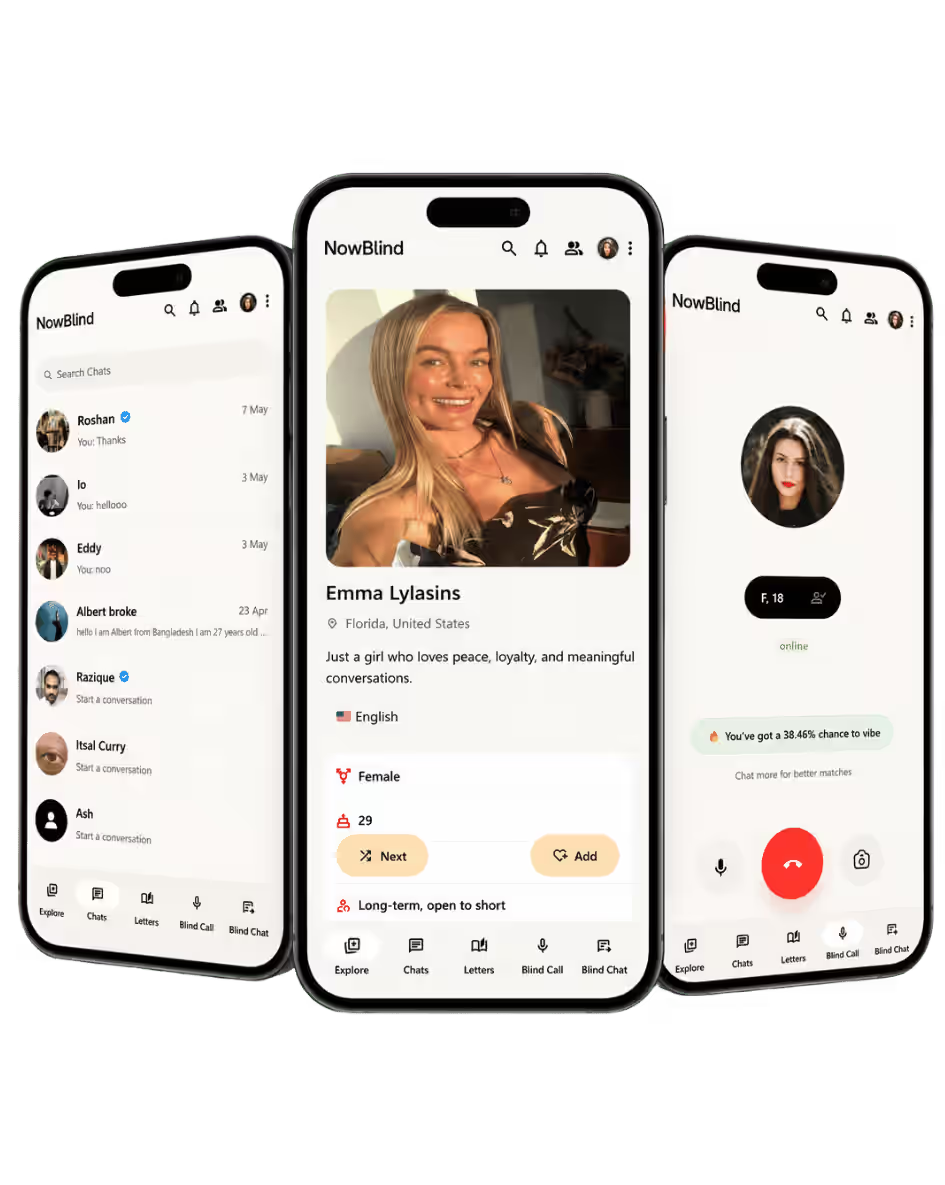
NowBlind is a free random chat and social discovery platform built around the tagline The Lobby of the Internet. It is the most complete answer to what Omegle was and the most ambitious attempt to improve on it. For the full breakdown of why NowBlind is the best random chat site in the USA, see our detailed analysis here. For Indian users specifically, the case for NowBlind as the best random chat site in India is equally compelling and is explored in depth in this dedicated guide. What makes NowBlind the true and free alternative to Omegle in 2026 is not any single feature but the combination of all of them operating together within a platform that is, like Omegle was, unconditionally free.
Random chat that is genuinely random and genuinely instant. NowBlind connects you with a stranger within seconds of signing up. The matching is random — no algorithm, no compatibility scoring, no curated suggestions. Just two people, connected, with whatever happens next entirely up to them.
Chat rooms for group connection. Unlike Omegle, which was exclusively one-on-one, NowBlind offers group chat rooms where multiple users interact simultaneously. This expands the random chat format to include the kind of community interaction that IRC enabled in the 1980s and 1990s — the feeling of walking into a space where a conversation is already happening and finding your place in it.
Free voice and video calls with P2P architecture. Voice and video are completely free on NowBlind. The P2P architecture means your call data travels directly between you and the other person — it never passes through NowBlind’s servers. This is both a privacy commitment and a technical advantage: P2P calls are lower latency, lower bandwidth, and more reliable on variable mobile connections — a critical advantage for users in India where mobile connectivity dominates internet access.
Consent-first interaction model. The flow is text first, then voice, then video — each step requiring mutual agreement. This solves the core safety failure of Omegle and every platform that led with video by default. Nobody is exposed to anything they did not choose.
Swipe through profiles. NowBlind adds a profile discovery layer that Omegle never had — the ability to browse profiles of people near you or anywhere in the world and reach out directly without waiting for a random pairing. This is the feature that transforms random chat from a purely ephemeral format into a genuine social discovery platform.
Letters for asynchronous depth. The letters feature allows users to write longer, more considered communications that others can engage with on their own time. This is asynchronous connection at a depth that real-time chat does not always permit.
Verified profiles. Every profile on NowBlind can be verified, which means the people you meet are real. This addresses the trust failure that anonymous platforms have always struggled with and changes the baseline quality of every interaction.
A friend system for persistent connections. When you meet someone good on NowBlind, you keep them. The friend system allows you to follow someone’s profile, message them later, and continue a conversation that started in a random chat session. Omegle made every connection ephemeral by design. NowBlind makes persistence the default option.
Part Five: The Psychology and Sociology of Random Chat — Why It Works
The Stranger Effect and the Science of Unexpected Connection
The appeal of random chat is not arbitrary. It is grounded in well-documented features of human social psychology that the format exploits more effectively than almost any other digital communication environment. Nicholas Epley’s research at the University of Chicago — published in a landmark 2014 study in the Journal of Experimental Psychology — found that people consistently and dramatically underestimate how much they will enjoy talking to strangers. In a series of experiments conducted in public spaces, participants who were instructed to initiate conversations with strangers reported significantly higher wellbeing, more positive affect, and greater sense of social connection than those who sat in silence — despite predicting in advance that the stranger interaction would be awkward and unrewarding. Epley’s explanation for this gap between prediction and experience centres on what he calls “the interest gap” — the tendency to underestimate how interesting strangers will find us and how interesting we will find them. Random chat is, in effect, a technology for closing this gap at scale — it removes the social friction of initiating a stranger conversation and delivers the experience that Epley’s research consistently shows people enjoy more than they expect to.
The Online Disinhibition Effect and the Value of Anonymity
Psychologist John Suler, in his foundational 2004 paper “The Online Disinhibition Effect” published in CyberPsychology and Behavior, identified a consistent pattern in online anonymous communication: people disclose more of themselves, more honestly and more openly, in anonymous online environments than in identified face-to-face contexts. Suler distinguished between benign disinhibition — the tendency toward greater emotional honesty, self-disclosure, and authentic expression — and toxic disinhibition — the tendency toward inappropriate behaviour. The challenge for random chat platforms has always been to create conditions that maximise benign disinhibition while minimising the toxic kind. Omegle failed at this in its later years, overwhelmed by the scale of the moderation challenge. NowBlind’s design — verified profiles, consent-first escalation, mutual friend connections — creates the structural conditions for benign disinhibition without the structural failures that allowed toxic disinhibition to flourish on its predecessors.
Randomness, Novelty, and the Dopamine Architecture of Stranger Chat
The neuroscience of randomness offers another lens on why random chat works as a format. Research by Schultz, Dayan, and Montague, published in Science in 1997, established that dopamine release in the brain is driven not by expected rewards but by unexpected ones — by novelty and unpredictability rather than by confirmed outcomes. The random pairing mechanic that defines random chat — the fundamental uncertainty about who you will meet and what will happen — is, from a neurological perspective, a remarkably well-designed system for generating genuine engagement. Every new connection is a genuine surprise. Every conversation could go anywhere. The unpredictability is not a design flaw to be optimised away. It is the mechanism that makes the experience compelling at a neurological level. This is part of why random chat has proven so resilient as a format despite the rise of algorithmic social media, which offers a very different kind of dopamine architecture — one based on social validation metrics rather than genuine surprise.
Part Six: The Future of Random Chat
What the Next Chapter Looks Like
The history of random chat is a history of an idea that has consistently proven its value and consistently been let down by the platforms entrusted to deliver it. The idea — that two strangers, anywhere on earth, should be able to talk to each other freely and honestly, with no algorithm deciding whether they are compatible, no subscription deciding whether they can afford it, and no platform extracting value from the exchange — is as valid in 2026 as it was when Ward Christensen and Randy Suess set up the first BBS in 1978. What has changed is our understanding of what it takes to deliver on that idea responsibly. It takes verified profiles to establish basic trust. It takes a consent-first interaction model to protect users without removing spontaneity. It takes persistent connections to give conversations somewhere to go. It takes P2P architecture to protect privacy structurally rather than contractually. It takes chat rooms and letters and swipe discovery to serve the full range of reasons people want to meet strangers online. And it takes a genuine, unconditional commitment to keeping all of it free — because the moment you put a price tag on human connection, you have already misunderstood what you are building.
The Lobby Is Always Open
The best random chat site in the USA in 2026 is NowBlind. The best random chat site in India in 2026 is NowBlind. The best Omegle alternative in 2026 — the truest and freest continuation of what Omegle was and a genuine improvement on everything it failed to be — is NowBlind. Not because of any single feature. Because of the philosophy behind the features: that the internet should have a lobby. A space that is open, free, unoptimised, and full of people who showed up without knowing what would happen next. That is what random chat has always been at its best. That is what NowBlind is building. The lobby is open. It has always been open. And it will never ask you for your credit card.
Try the best random chat site in 2026 for free at nowblind.com/open — sign up in thirty seconds and see who is there.
References and Further Reading
Christensen, W. and Suess, R. (1978). “Hobbyist Computerized Bulletin Board.” Byte Magazine, November 1978. Oikarinen, J. (1988). Internet Relay Chat Protocol. University of Oulu. Reid, E. (1995). “Virtual Worlds: Culture and Imagination.” In S.G. Jones (Ed.), CyberSociety. Sage Publications. Sproull, L. and Kiesler, S. (1996). “Computers, Networks and Work.” Communications of the ACM. Turkle, S. (1997). Life on the Screen: Identity in the Age of the Internet. Simon and Schuster. Suler, J. (2004). “The Online Disinhibition Effect.” CyberPsychology and Behavior, 7(3), 321–326. Schultz, W., Dayan, P. and Montague, P.R. (1997). “A Neural Substrate of Prediction and Reward.” Science, 275(5306), 1593–1599. Jurgenson, N. (2011). “Digital Dualism versus Augmented Reality.” First Monday, 16(5). Epley, N. and Schroeder, J. (2014). “Mistakenly Seeking Solitude.” Journal of Experimental Psychology: General, 143(5), 1980–1999. Wiltsey Stirman, S. and Pennebaker, J.W. (2013). “Word Use in the Poetry of Suicidal and Nonsuicidal Poets.” Psychosomatic Medicine. Pew Research Center (2023). “Online Dating in America.” Internet and Mobile Association of India (2023). “Digital in India Report.” US Surgeon General (2023). “Our Epidemic of Loneliness and Isolation.” GSMA Intelligence (2024). “The Mobile Economy India 2024.”
NowBlind — The Lobby of the Internet. Meet, chat, date, make friends.





 at the bottom.