

 Start Blind Chat
Is Random Chat Safe? The Complete 2026 Guide to Stranger Chat Safety
Is random chat safe in 2026? Learn the real risks, the red flags to watch for, and how platforms like NowBlind are built differently — with P2P calls, ephemeral chats, and no data profiling.
The short answer: it can be — but “random chat” covers a wide range of platforms, and the safety gap between the best and worst ones is enormous.
If you have been searching for a safe random chat app, a trustworthy Omegle alternative, or simply trying to figure out whether talking to strangers online is worth the risk in 2026, this guide is for you. We cover the real risks (not inflated, not dismissed), what the research and history of the space actually show, what separates a safe stranger chat platform from an unsafe one, and how modern apps like NowBlind are built differently from the platforms that earned random chat its reputation problem.
By the end of this article you will know exactly what to look for, what to avoid, and how to protect yourself — regardless of which platform you decide to use.
Why Random Chat Safety Matters More Than Ever in 2026
Random chat as a category has been through a lot. The complete history of random chat covers the full arc — from the original Chatroulette era through Omegle’s peak and eventual shutdown — but the short version is this: the original wave of stranger chat platforms grew so fast that safety infrastructure couldn’t keep up. Minimal moderation, no age verification, and server-side storage of conversations created real problems, and those problems were what ultimately pushed Omegle out of existence in November 2023.
The platforms that have emerged since then have had to decide how seriously to take that lesson. Some have taken it seriously, building with privacy and moderation at the architecture level rather than bolted on as an afterthought. Others are quick clones that copied the interface without learning anything from what went wrong.
The result is a category where the safety level of any given platform depends enormously on which one you’re using — which is exactly why a guide like this exists.
The Real Risks of Talking to Strangers Online
Let’s be direct about what the actual risks are, rather than either dismissing them or inflating them. Random chat has three categories of meaningful risk, and understanding them separately is more useful than a vague “be careful online” warning.
1. Exposure to Inappropriate or Harmful Content
This is the most commonly cited risk, and it is real on platforms with weak moderation. Unsolicited explicit content, harassment, and offensive behavior all become more likely when a platform has no functioning reporting or enforcement system. On poorly moderated platforms, users — especially younger ones — can encounter content they didn’t ask for and don’t want to see.
What mitigates it: Platforms with consent-based escalation (text before voice before video, with mutual agreement required at each step), active reporting tools, and real enforcement of community guidelines reduce this risk significantly. An ephemeral chat model — where conversations aren’t stored — also disincentivizes some forms of harassment by removing the ability to screenshot-and-share for later use.
2. Privacy and Data Risks
Many people using random chat apps don’t think about what happens to their conversation after it ends. On some platforms, chat logs, IP addresses, device identifiers, and even video session metadata are stored on servers, sometimes indefinitely. This matters for a few reasons: it creates a data profile you didn’t consent to, it can be subpoenaed in legal proceedings, and it represents a potential breach target.
What mitigates it: Platforms built around peer-to-peer calls (where audio and video travel directly between devices, bypassing company servers) and ephemeral chat sessions (where text is deleted once a session ends) dramatically reduce this risk. Reading a privacy policy specifically for what data is collected and how long it’s retained is worth doing before trusting a platform with your voice or face.
3. Social Engineering and Scam Attempts
Random chat platforms attract a small but consistent minority of users whose goal is to extract something from a conversation — money, personal information, or access to other accounts. Common patterns include building quick rapport before asking for help with a financial emergency, presenting as a recruiter or business contact to extract professional details, and gradually steering conversations toward increasingly personal topics.
What mitigates it: Not sharing personal financial information with anyone you’ve just met online, full stop — regardless of how natural the conversation has felt. Treating unsolicited asks for money, gift cards, or cryptocurrency as an automatic red flag.
What Legitimate Random Chat Platforms Don’t Do
A useful way to evaluate any stranger chat app is to look at what the safer ones have stopped doing, compared to what the earlier generation of Omegle-era platforms did by default.
| Practice | Older Omegle-Era Platforms | Modern Safe Platforms |
|---|---|---|
| Storing chat logs on servers | Common | Ephemeral — deleted after session ends |
| Routing voice and video through company servers | Standard | Peer-to-peer — bypasses company servers entirely |
| Age verification | Absent or superficial | Explicit 18+ policy with account requirement |
| Moderation | Minimal, reactive | Client-side tools, reporting, blocking built into the UI |
| Ad tracking and behavioral profiling | Common | Absent on privacy-first platforms |
| Gender / content filters as a safety tool | Not available | Available free on better platforms |
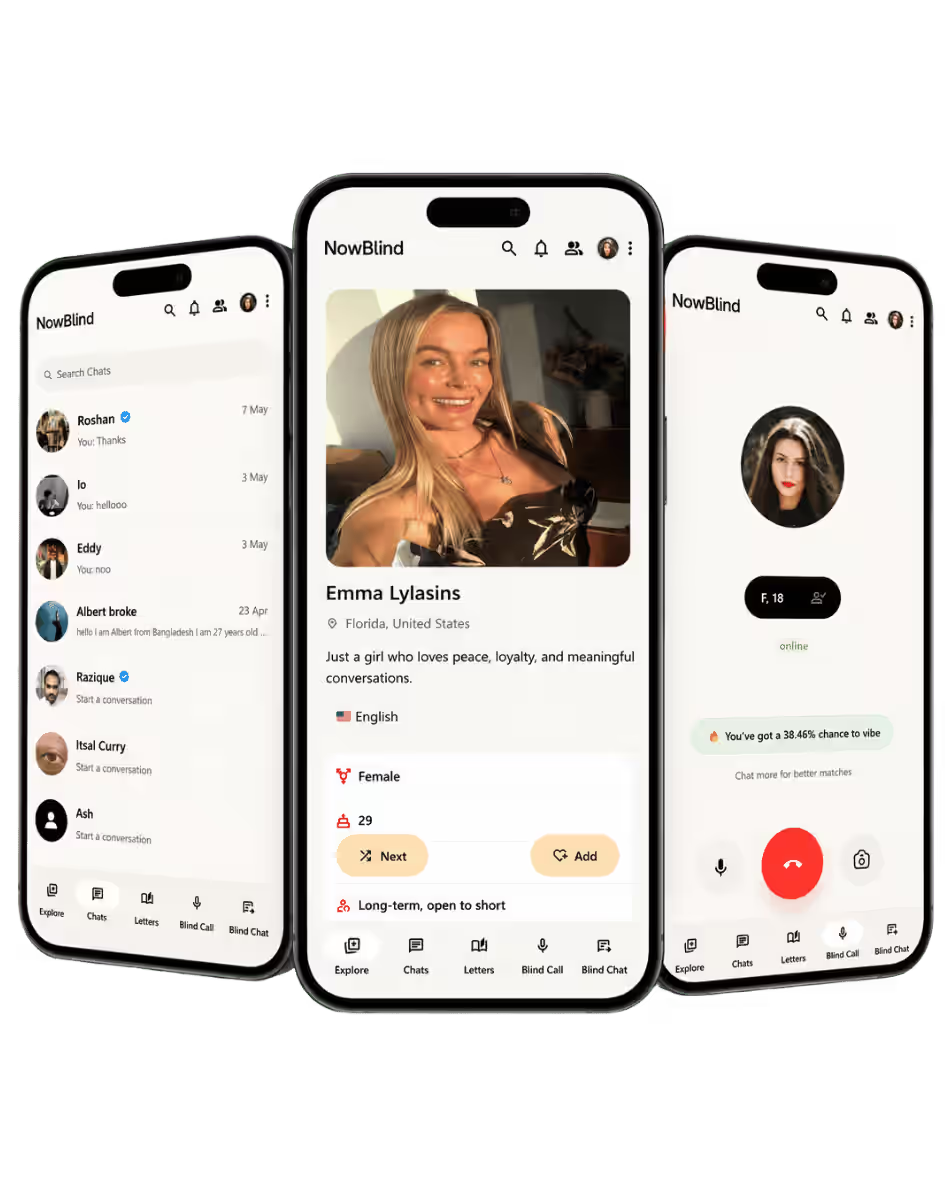
NowBlind, for example, uses ephemeral text sessions, peer-to-peer voice and video routing, and client-side moderation tools — meaning the audio and video in your call never pass through NowBlind’s servers, and your text session is deleted once it ends. That’s a structural safety approach, not just a policy claim.
How to Stay Safe on Any Random Chat App: 10 Practical Rules
These rules apply regardless of which platform you use. They cover the most common ways random chat goes wrong and the simplest ways to reduce that risk.
Rule 1: Never Share Financial Information
No legitimate random conversation will require you to share bank details, cryptocurrency addresses, card numbers, or any information that could be used for financial access. If a conversation turns toward money — receiving or sending — end it.
Rule 2: Treat Personal Identifiers as Private Until Established Trust
Your full name, home address, employer, daily schedule, and the schools you or your family members attend are details that build a map of your life. There’s no reason to share any of them with someone you met in a random queue ten minutes ago.
Rule 3: Use Platforms That Let You Start in Text
The text → voice → video flow that modern platforms like NowBlind use isn’t just a UX choice — it’s a safety feature. Starting in text gives you time to read the conversation before putting your face and voice into it. If a platform pushes you straight into video with no option to start in text, that’s worth noticing.
Rule 4: Use the Report and Block Tools Every Time They’re Needed
Reporting isn’t just about protecting yourself — every report you file makes the platform marginally safer for the next person. A platform that doesn’t have easily accessible, one-tap reporting and blocking is a platform that isn’t taking safety seriously.
Rule 5: Be Cautious About What’s on Screen Behind You
When you’re on a random video call, everything visible behind you is also visible to the stranger on the other side. Street signs visible through a window, mail on a table, or the name of your workplace on a background item can tell someone more than you intended. A neutral background — or a blurred one if the platform supports it — is an easy precaution.
Rule 6: Don’t Move the Conversation to Another Platform Too Quickly
A common pattern in social engineering via random chat is to quickly push the conversation to a different platform — WhatsApp, Instagram, Telegram — before you’ve had time to properly evaluate who you’re talking to. There’s nothing wrong with eventually moving a good conversation elsewhere, but doing it within the first five minutes of meeting someone is worth being cautious about.
Rule 7: Trust Your Instincts About a Conversation’s Direction
If a conversation has started feeling uncomfortable, manipulative, or off in a way you can’t quite name, you don’t need to justify ending it. Random chat is built around the ability to move on at any time — use it.
Rule 8: Know That Anonymity Has Limits
Most random chat platforms give you a degree of anonymity, but it isn’t absolute. Your IP address is typically visible to the platform itself (and sometimes briefly to the other party in P2P connections), and anything you show on camera or say in voice can be recorded client-side by the other person without the platform’s involvement. Don’t rely on anonymity as a substitute for good judgment.
Rule 9: Check the Privacy Policy Before Trusting a Platform With Your Face
It takes about three minutes to search a platform’s name and “privacy policy” and skim what it says about data retention. Specifically look for: how long chat logs are stored, whether voice and video sessions are recorded or processed server-side, and whether your data is used for advertising. Platforms that are vague on all three are worth treating with additional caution.
Rule 10: Use Platforms With an Explicit Age Policy
If a platform doesn’t have a clearly stated minimum age requirement and an account-level mechanism to enforce it, that’s a meaningful signal about how much thought has gone into the safety infrastructure overall. Legitimate platforms in this space are explicit about who the product is for.
What Makes a Random Chat App Actually Safe? A Framework
When evaluating whether a specific stranger chat app is worth your trust, there are five dimensions that matter more than anything else.
Architecture: Where Does Your Data Actually Go?
This is the most important and least-discussed dimension of random chat safety. On a peer-to-peer platform, your voice and video travel directly from your device to the other person’s device. On a server-routed platform, that same audio and video pass through a third-party server — which means it can theoretically be stored, analyzed, or accessed. Ask the question explicitly: does my voice and video go through your servers? Platforms that can answer “no” and explain how are worth significantly more trust than platforms that are vague about it.
Moderation: Is It Real, or Just a Policy Page?
Real moderation means: a report button that’s easy to find in the middle of a conversation, not buried in settings. A block function that works immediately. Community guidelines that are actually enforced rather than just listed. Evidence that the platform has responded to reported violations. Absence of any of these doesn’t mean a platform is dangerous, but it does mean you’re relying entirely on your own judgment rather than any platform-level safety net.
Transparency: Does the Platform Say What It Does With Your Data?
A clear privacy policy that specifically addresses retention periods, data sharing practices, and advertising use is a baseline for any platform worth trusting in 2026. Generic privacy policies that copy-paste boilerplate language without addressing the specifics of a live video chat platform are a yellow flag.
Consent: Can You Control How a Conversation Escalates?
Platforms that move you straight into video with another stranger, with no option to start in text or voice, remove a layer of control that matters for safety. Platforms that require mutual consent before escalating from text to voice to video — where neither person can unilaterally force the conversation into a more intimate medium — give you meaningfully more control over your experience.
Community Standards: Who Is the Platform Actually For?
A platform that is explicit about being built for adults, that requires an account rather than truly anonymous access, and that has stated community guidelines isn’t just better regulated — it tends to attract a more intentional user base. The presence of filters for shared interests, colleges, and languages also signals a platform designed for genuine conversation rather than shock value.
How NowBlind Is Built for Safety
NowBlind’s approach to safety is built into the architecture rather than layered on top as a set of policies. Here’s specifically what that looks like in practice.
Ephemeral text chats. Once a text session ends, the chat is deleted. It isn’t stored on NowBlind’s servers after the fact, which means there is no server-side chat log that could be accessed, subpoenaed, or breached.
Peer-to-peer voice and video. Voice and video calls on NowBlind are routed directly between the two devices in the conversation. Your audio and video never pass through NowBlind’s servers — they literally cannot be stored at the infrastructure level because the infrastructure is never in the middle of the call.
Client-side moderation. Moderation tools run on-device where possible, reducing how much content ever reaches NowBlind’s servers in the first place. This is a privacy benefit as much as a safety one — less data centrally processed means a smaller attack surface and a smaller data footprint overall.
Consent-based escalation. Text, voice, and video are three distinct steps on NowBlind, and each step requires mutual agreement before the conversation escalates. You can stay in text indefinitely; moving to voice or video is a joint decision, not something one person can force.
Minimal tracking. NowBlind collects only what is necessary to run the platform. No ad tracking, no behavioral profiling — which matters for both privacy and the kind of monetization incentives that can push other platforms toward data collection practices that don’t serve users.
For a detailed breakdown of NowBlind’s full feature set alongside the rest of the random chat field, see our comparison guide: Best Omegle Alternatives in 2026.
Safe Random Chat by Region: What Changes, What Doesn’t
The core safety principles above apply everywhere, but the random chat landscape does vary by geography in ways worth knowing.
In the United States
The USA has the highest concentration of active random chat users of any single country, which means the highest match volume — but also the highest variability in who you might be matched with. If you’re specifically looking for the best experience in the US, our dedicated guide covers what the user base looks like by region and time zone: Best Random Chat Site in the USA (2026).
Random chat safety in the US sits within a legal framework where platforms face meaningful liability for certain categories of harm — which is part of why legitimate US-based or US-accessible platforms have had to get serious about moderation and age policies in a way that smaller, less accountable clones haven’t.
In India
India is one of the largest and fastest-growing random chat markets in the world, with millions of users across cities like Mumbai, Delhi, Bangalore, Hyderabad, and Chennai. The filtering tools that matter most in India tend to be language-based (filtering by Hindi, Tamil, Telugu, Bengali, and other regional languages) and interest-based, because the diversity of the user base is enormous.
For a full breakdown of the random chat landscape in India and what safe options look like in that market specifically, see: Best Random Chat Site in India (2026) and Best Random Chat in India.
Globally
Random chat users in Europe benefit from GDPR protections that create specific legal obligations around data retention and user rights. Users in other markets should check whether the platform they’re using is subject to any privacy regulation at all, or whether it operates in a regulatory grey zone. A platform that is transparent about its data practices regardless of legal obligation is more trustworthy than one that only complies when required.
Red Flags: Signs That a Random Chat App Is Not Safe
If you’re evaluating a platform you haven’t used before, these are the signals that should give you pause.
No stated age policy at all. Not “18+” enforcement that’s easy to circumvent — no policy whatsoever. This is one of the clearest signals that safety was not a priority in the platform’s design.
Vague or boilerplate privacy policy. If a privacy policy doesn’t specifically address how video sessions are handled, how long chat logs are retained, and whether data is used for advertising, assume the worst-case answer to all three.
No reporting or blocking tools visible in the conversation UI. If you have to leave the conversation, navigate to settings, and hunt for a reporting form, the platform isn’t serious about moderation.
“No moderation” marketed as a feature. Some platforms specifically promote the absence of content restrictions as a selling point. This is the inverse of what you want if safety is a priority.
Excessive app permissions. A random chat app has no reason to request access to your contacts, your full photo library, or device identifiers beyond what WebRTC requires to function. Anything further than that should prompt the question of why.
Immediate push toward off-platform communication. If the platform itself (not just a user within a conversation) pushes you toward giving out a personal number or moving to another app before you’ve established any trust, that’s a sign the platform’s interests may not align with yours.
Frequently Asked Questions About Random Chat Safety
Is random chat safe in 2026?
It depends heavily on the platform. The best options — those built with peer-to-peer calls, ephemeral chats, real moderation tools, and explicit age policies — are meaningfully safer than the Omegle-era platforms that gave the category its reputation problems. The worst options in the current field have learned little from that history. The criteria in this guide will help you tell the difference.
Can strangers find out where I live from a random chat app?
On most platforms, direct location (your street address, neighborhood, or city) isn’t automatically revealed. Your IP address is typically visible to the platform and may be briefly visible in P2P connections — which means someone with technical knowledge could make a rough guess about your city or region. Avoid turning on location-based filters on platforms you don’t trust, and be aware that anything you say or show on camera can reveal location details you didn’t intend to share.
Is random video chat safe?
Random video chat carries more exposure than text chat by definition — you’re putting your face and voice into a session with a stranger. The safeguards that matter most are: starting in text before moving to video, using a neutral or blurred background, using platforms where video is peer-to-peer and not server-side recorded, and having a functioning block button within immediate reach.
What should I do if I see something inappropriate on a random chat app?
Use the platform’s report button immediately. Most platforms with real moderation (NowBlind, Chatroulette, OmeTV among others) have a report function directly accessible within the conversation interface. Reporting matters both for your own protection and for the overall safety of the community.
Is NowBlind safe to use?
NowBlind is designed around several genuine safety features: ephemeral text chats that are deleted after sessions end, peer-to-peer voice and video that never routes through NowBlind’s servers, consent-based escalation from text to voice to video, and minimal data collection with no ad tracking or behavioral profiling. As with any online platform, personal judgment still matters — but NowBlind’s architecture is one of the more privacy-forward designs in the current random chat field.
Are random chat apps safe for college students?
For college-age adults using a platform designed for adults, random chat carries similar risks to any online interaction with strangers — manageable with good judgment and the right platform. The college and university filter on NowBlind is worth noting specifically, as it lets students connect with people from their own or specific other institutions — a more structured context than purely blind random matching.
What happened to Omegle and why does it matter for safety?
Omegle shut down in November 2023 after years of safety concerns and mounting legal pressure. Its founder cited the platform’s misuse as the reason for closure. The lesson for the current generation of random chat apps is clear: platforms that don’t take safety seriously at the architecture level face the same pressures Omegle did. This is part of why the better options in today’s market have built safety in rather than tacking it on. For the full story, see: The Complete History of Random Chat.
Conclusion: Random Chat Is Safe When the Platform Earns That Trust
The question “is random chat safe?” doesn’t have a single answer — it has an answer for every platform in the space, and those answers vary enormously. The best options in 2026 are genuinely safer than anything that existed in the Omegle era, built from the ground up with data minimization, peer-to-peer architecture, and consent-based conversation flows that give users real control.
The worst options in 2026 are the same kind of poorly moderated, data-collecting clones that created the safety reputation problem in the first place — just with a fresh coat of marketing paint.
The practical conclusion is that random chat, used thoughtfully on a platform that takes safety seriously at the architectural level, is a genuinely reasonable way to meet and talk to new people online. Used carelessly on a platform that doesn’t, it carries real and unnecessary risks.
NowBlind was built around the belief that those risks are eliminable at the platform level — through P2P calls, ephemeral chats, consent-based escalation, and minimal data collection — rather than something users should just accept as the cost of entry. If you haven’t tried it yet, the lobby is open: start a conversation on NowBlind for free, right now.





 at the bottom.